GETTING INTO HOT WATER
SONIC LIGHTHOUSE

Sonic Lighthouse 1
Call to The Fishes: Hinkley Point C
April 2024

The Severn estuary is an important habitat for all sorts of creatures, fishes in particular, salmon and eel specifically.
Hinkley Point C nuclear power plant, which is currently under construction will suck huge amounts of water from the estuary and Bristol Channel into it's cooling systems taking hundreds of thousands of fish with it and killing them in the process.
The first solution to this problem proposed by EDF, the plant developers was to install 300 underwater sound projectors which would have 'boomed noise louder than a jumbo jet' into the sea to deter fish from entering the intake pipe. However, this idea was abandoned out of concern for the divers who would have to install and maintain the system in the dangerous, fast-flowing waters and the impact the noise would have on porpoises, seals and whales.
Accepting the loss of tonnes and tonnes of fishes, EDF's proposed 'compensation' is to create a new salt marsh along the nearby River Parrett on wildlife-rich grassland managed by local landowners. This has not gone down well either!
So it seems the fish will just have to be sacrificed in the name of progress...
We were appalled and distressed by this so embarked on a 'very dangerous field trip' to Hinkley Point with our friend and poet 'Roving Rick'. We call to the fishes through our Sonic Lighthouse apparel, both warning them of the impending danger and yearning for those who are yet to be lost .
We made a radio programme for our regular show, Radio Public on Resonance FM based on our adventures which can be heard here
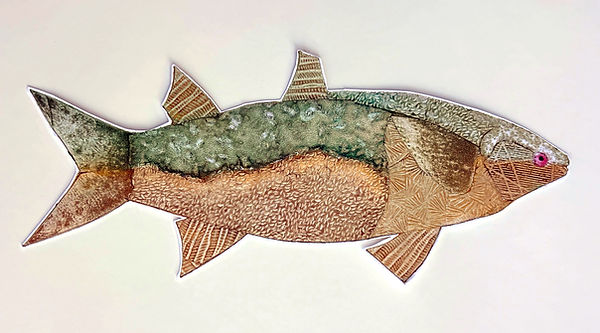
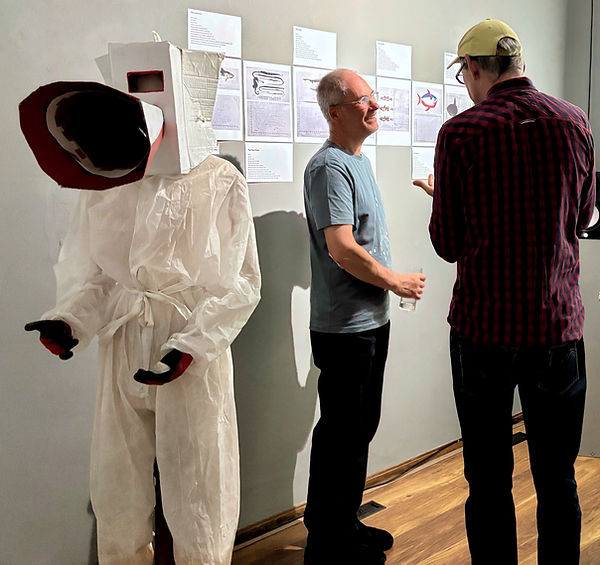
We made a 'Call to the Fishes' film which was first shown as an element of an art installation at CoLab Dudley on 17th April 2024. As well as the film, the work included our Sonic Lighthouse apparel, suspended paper fishes and a quadraphonic soundtrack.


Images from the Sonic Lighthouse installation at CoLab Dudley, April 2024

4th World Congress of Psychogeography
Canterbury 2024

Fish headdress created by Elena Thomas

In September 2025 we took Sonic Lighthouse to the 4th World Congress of Psychogeography at the University of Canterbury. Our installation filled the whole lecture theatre, engaging audiences with the 'Call to the Fishes' film and quadrophonic soundtrack.


Lively discussion took place at three artist talks we gave during the congress, with appreciation for our critical engagement with a little-known issue.
CHAIN REACTION

Between September 2024 and June 2025 Sonic Lighthouse has slowly but inorexably transformed into an artistic method. A kind of chain reaction is happening whereby the energy and learning from the previous event causes the next one, a positive feedback situation of self-perpetuating amplification...
This reflects the nuclear reaction process going on at Hinkley Point C and the molecular arrangement of long chain carbon atoms with fluorine atoms in the 'forever chemicals' we have also become interested in.
General Office Gallery
Stourbridge 2026

Elena Thomas adjusting her fish headdress – part of the installation at General Office, July 2026
In the summer of 2026 the creative chain reaction process reversed and we began to explore the visual and sonic fallout of Sonic Lighthouse. Reflecting on the body of work helped us realise it was unfinished and that the ongoing story of fish injustice requires our continued attention. Rather than generating another outward response, the accumulated body of work became the catalyst for further inquiry. Reflection itself became productive, revealing Sonic Lighthouse as an evolving practice rather than a completed project.
This prompted us to revisit Stolford Beach and the Hinkley Point nuclear site. The return trip was not a repeat of our earlier journey, but an encounter with the place differently. Returning to the beach, catching up with Rick and his more recent nuclear poems, and searching for developments in the fish-pipe situation at Hinkley Point C reinforced the importance of sustained attention to this place and issues that continue to evolve over time. Revisiting became both a creative and ethical act rather than simply a means of gathering new material.
In July we created a new installation at General Office Gallery that reimagined and reworked earlier visual and sonic pieces, treating them as living materials that could be rearranged into new relationships, allowing reflection itself to become a generative part of the artistic process.
With support from Simon and Sarah at General Office Gallery, we presented a new four-hour ambisonic sound work that sought to immerse listeners within an entangled sonic ecology. The composition wove together the pulse of fishes, the recurring call of the Sonic Lighthouse, the rhythms of tides and deep time, the mechanical presence of nuclear power and the extended temporalities suggested by the half-life of radioactive materials. Rather than separating natural and industrial worlds, the work explored how these diverse rhythms coexist, overlap and shape one another.
A new video and photographic series similarly worked across changing scales of attention. Beginning with the micro-growths and subtle movements of Stolford Beach, expanding towards the accumulating cloudscape above the reactor, and returning to the instructional and warning signage encountered on site, the work invited viewers to consider how ecological processes, industrial infrastructures and everyday acts of observation are held together within the same landscape. In doing so, Stolford Beach emerged as a place where multiple human and more-than-human stories continue to unfold.


Collaboration extended beyond the works on display to shape the exhibition itself as a space of shared inquiry.
A selection of Rick's 51 Fishes poems, inspired by The Observer's Book of Sea Fishes (1962), was exhibited alongside his more experimental nuclear redaction works. Together, the poems moved between careful observation and poetic disruption, echoing the wider themes of ecological fragility, industrial intervention and more-than-human entanglement explored throughout Sonic Lighthouse.
During the exhibition, Rick's live poetry reading transformed the gallery into a participatory event. His spoken poems acted as invitations to conversation, prompting visitors to reflect on their own relationships with fishes and the often-unseen consequences of nuclear infrastructures.
In the same spirit, we (Helen and Bill) consciously chose to remain present throughout the exhibition, recognising conversation as an integral part of the work. We wanted the gallery to function as a place where artworks, poetry, sound and dialogue could come together, enabling visitors to share their own experiences, questions and perspectives.
These exchanges became another layer of the installation, extending the creative chain reaction beyond the exhibited works themselves. Rather than presenting a finished statement, the exhibition remained open to dialogue, with the artworks acting as catalysts for reflection, discussion and renewed attention to our relationships with fishes, nuclear infrastructures and the more-than-human world.
The creative chain reaction continued beyond the gallery through another collaborative outcome. Bill produced the hour-long radio programme Sonic Sea and Digital Fish (Episode 39) for our Radio Public series on Resonance FM.
The programme did not simply document the exhibition; it translated and extended its themes into a different medium, carrying the inquiry to new listeners while weaving together sound, conversation and reflection. In doing so, the radio broadcast became another stage in the evolving life of Sonic Lighthouse, with the work continuing to generate new forms of artistic response and public engagement rather than reaching a fixed conclusion.
A selection from 51 Fishes
by Rick Sanders
The Armed Bullhead
Strange
Little fish
Armed Bullheads wish
For a simple existence
Eggs laid against the resistance
Of winter conditions their small fry
Hatch out in spring swim up try
To survive at the surface with stoic persistence
Then away to the depths as if in remembrance
Of past generations called down to the shadows to die
Upon the seabed of life spent on the bottom rung shy
Little barnacled survivor rarely venturing out happy just to
ride the tides
The Cod Kind
Carnivorous
Cod kind
You will find
Them in many forms
Deep sea fishes avoiding storms
Coalfish Whiting Pollack Ling Bib Cod
Greater Forkbeard and even the Poor Cod
Are all familiar fish on trawlers metal platforms
Argued over Cod Wars paved the way for reforms
Redrawing boundaries fishing rights bureaucrats capitalists
seeing themselves as God
Poisidon looks on unimpressed urging cod kind fishes to ride
roughshod
Wherever they wish and they do of course they do they're fish
The Angler Fishes
Angler
Fishes fish
For other fish
Cannibal lurer victim attracter
Taken in by seabed lurker
All teeth in its bristling gape
Flap of shiny skin attached to ape
An easy bite bobs on dorsal fin projector
Irresistible it seems yet this fish is a strander
Washed up on shores for folk to mock its shape
Freak show gatherers ponder on its cause its method of escape
From depths unseen and unexplored where monsters such as
these take ward
For more information about our practice please look here on the Workshop 24 website